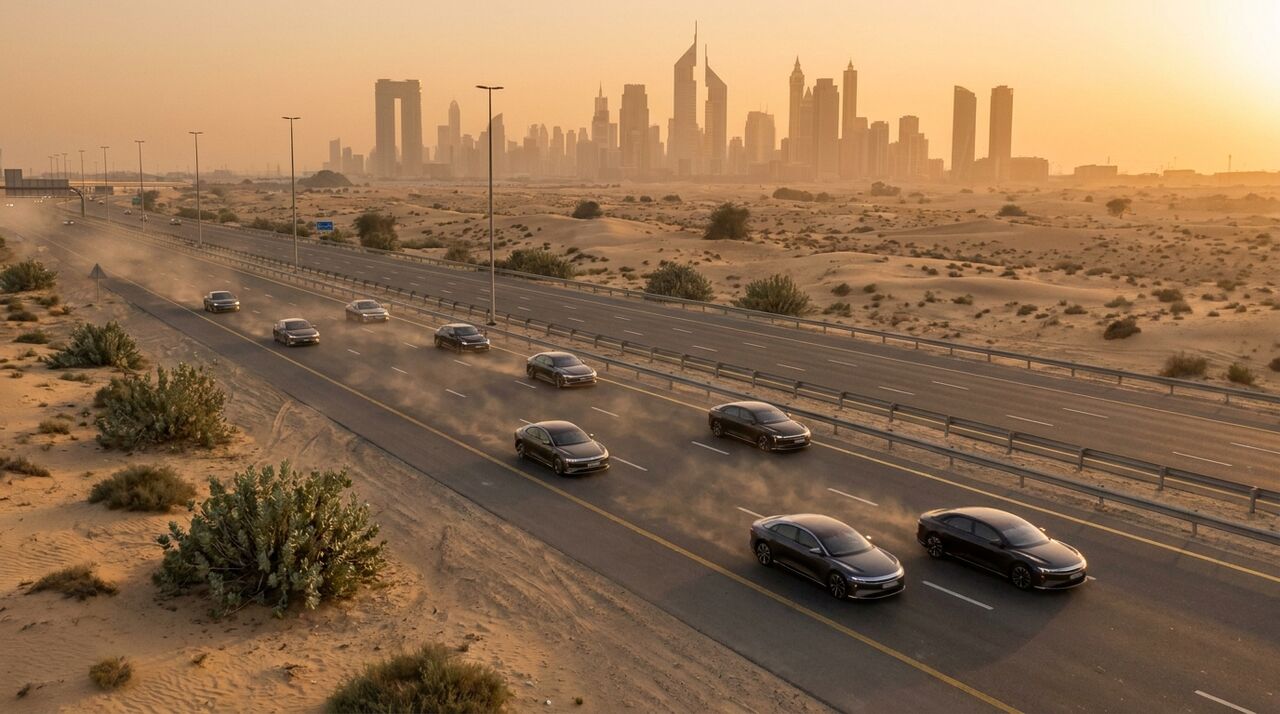
Eighteen months ago, a NIO ET5T on a Dubai street was a curiosity. Today, it is a regular sighting on Sheikh Zayed Road — and almost every week, our showroom takes a deposit on one. The shift is not a feeling. It is a measurable change in the UAE car market that almost no Western press has picked up on. This post is the data we run our business on, with every number sourced.
Why is the UAE adopting EVs faster than its GCC neighbours?
The UAE has bound EV adoption into federal policy: a 50% electric-and-hybrid target by 2050, a 42,000-charger Green Mobility 2030 build-out, free DEWA Green Charger access for residents, Salik exemptions for EV plates, and a 10% electric-taxi mandate by 2026. No other GCC state has all five line-items in published strategy at once.
The UAE Ministry of Energy & Infrastructure publishes a target of 50% electric and hybrid by 2050 (UAE Ministry of Energy & Infrastructure, 2024), with the federal "Green Mobility 2030" framework calling for at least 42,000 charging points across the country by the end of the decade (UAE Ministry of Energy & Infrastructure, 2024). As of the most recent DEWA disclosure, Dubai alone hosts more than 1,000 public EV Green Charger outlets (DEWA, 2026), with most clustered along Sheikh Mohammed Bin Zayed Road, Al Khail Road, and through the major retail nodes — Dubai Mall, Mall of the Emirates, City Walk, and Marina.
The policy spine is unusually direct. Dubai residents charging at DEWA Green Chargers paid nothing for the first several years of the programme, and ETC-free Salik passages still apply to fully electric plates. RTA's 2026 fleet renewal target moves 10% of taxi and limousine vehicles to electric (RTA Dubai, 2026), with Careem and Tawasul reading the same memo. None of this is theoretical: it is line-item in published government strategy.
What tariffs apply to Chinese EVs imported into the UAE?
Chinese EVs entering the UAE pay only a 5% GCC customs duty at first port of entry plus 5% federal VAT — roughly 10% combined and no anti-dumping levy. By contrast, the EU's 2024 provisional countervailing duties on Chinese EVs reach up to 38%, and US tariffs effectively price Chinese-brand EVs out of the consumer market. The UAE is structurally open.
The detail Western analysts often miss: under the GCC Common Customs Law, motor vehicles imported into the UAE attract a 5% customs duty at the first port of entry (Federal Customs Authority, GCC Common Customs Law), plus the federal 5% VAT (Federal Tax Authority, 2018). There is no anti-dumping levy on Chinese EVs in the GCC. Compared to the EU's 2024 provisional countervailing duties on Chinese EVs of up to 38% (European Commission, 2024), or US tariffs that effectively priced Chinese-brand EVs out of the consumer market, the UAE looks structurally open.
On the supply side, the China Passenger Car Association reports that 2024 new-energy passenger vehicle sales in China crossed 11 million units (CPCA, 2025), with the used-NEV (二手新能源车) sub-market — the one we draw from every morning — running near 1.8 million units a year and growing (CPCA, 2025). That second-hand pool is structurally large: Chinese first-owner cycles for tech-forward sedans are often 18–30 months, far shorter than UAE re-sale norms. The result is a steady flow of low-mileage 2024 NIO ET5T units through verified China supply channels.
How much do Chinese EVs cost UAE-delivered in AED?
UAE-landed Chinese EV prices in 2026 run roughly AED 95k–210k inclusive of 5% VAT, RTA registration, ocean freight to Jebel Ali, and a 12-month workshop warranty. BYD Han EV sits at AED 95k–135k, NIO ET5T 75 kWh at AED 105k–148k, ZEEKR 001 at AED 155k–205k, and Xiaomi SU7 Pro at AED 160k–210k. Bands refresh daily at 06:00 GST.
Below is the customer-facing AED price band from our verified China supply records for the six Chinese-brand models we track most heavily, including 5% VAT, RTA registration, ocean freight to Jebel Ali, and a 12-month workshop warranty.
| Model | Year band | AED band | Tesla comparable AED |
|---|---|---|---|
| NIO ET5T 75 kWh | 2023–2024 | AED 105,000 – 148,000 | Model 3 LR (2022–2023) AED 135–175k |
| NIO ET5T 100 kWh | 2023–2024 | AED 135,000 – 175,000 | Model 3 LR (2024) AED 160–195k |
| BYD Han EV | 2023–2024 | AED 95,000 – 135,000 | Model 3 SR (2023) AED 125–150k |
| ZEEKR 001 100 kWh | 2023–2024 | AED 155,000 – 205,000 | Model Y LR AED 170–215k |
| Xiaomi SU7 Pro 94 kWh | 2024 | AED 160,000 – 210,000 | Model 3 Performance AED 195–235k |
| Li Auto L7 hybrid | 2023–2024 | AED 145,000 – 185,000 | No direct Tesla comparable |
These bands move within the week. The full snapshot — same six models, full rows, with mileage, battery state-of-health, and listing city — refreshes every morning at 06:00 GST and is downloadable as CSV or via the JSON API.
Who is buying Chinese EVs in the UAE in 2026?
Three buyer archetypes dominate UAE Chinese-EV demand in 2026: price-conscious upgraders moving off a 2018–2020 Tesla Model 3 SR+ at under AED 150k (NIO ET5T 75 kWh wins), second-car families adding an urban EV to a G-Wagen household (Li Auto L7 or NIO ES6), and early-adopter men aged 28–38 waiting on Xiaomi SU7 delivery.
The buyer profile we see day-to-day in our Al Aweer showroom maps cleanly onto three archetypes:
- The price-conscious upgrader. Currently driving a 2018–2020 Tesla Model 3 SR+ or a Hyundai Ioniq 5. Wants more range and a quieter cabin without breaking AED 150k. NIO ET5T at the 75 kWh trim wins this segment outright, often coming in 25–35% below a comparable Tesla.
- The second-car family. Already has a G-Wagen or Range Rover at home. Wants an urban EV for the wife / driver / school run. Cabin quality and back-seat space matter more than 0-100 km/h. Li Auto L7 or NIO ES6 lands here.
- The early-adopter male buyer, 28–38. Reads Bilibili reviews. Has been waiting for the Xiaomi SU7 since launch. We can usually deliver in 6–10 weeks — see our SU7 availability deep-dive.
What unites all three groups: they did the price comparison themselves before walking in. Almost every buyer who reserves a viewing has already pulled the same model on a Tesla showroom in the same week. The job in the room is not selling Chinese EVs — it is selling import logistics and aftercare.
What are the most common Chinese-EV service problems in the UAE?
Three failure modes dominate 2024–2025 UAE Chinese-EV service intakes: coolant-pump and thermal-management harness wear on early NIO ET5/ET5T builds, 12V auxiliary battery degradation accelerated by Dubai summer heat, and soft-touch dashboard wrap delamination from cabin temperatures. None are dealbreakers; all are predictable and pre-stocked by competent workshops.
There is no shortage of Chinese-EV listings on Dubizzle. There is a profound shortage of workshops that can replace a HV battery module, recalibrate a BMS, or read a NIO Aspen OTA log. The first generation of grey-market importers solved supply and then ghosted their buyers when an air-suspension airbag leaked at 18,000 km.
Our own service log, run out of the Al Aweer partner workshop, shows the top three Chinese-EV failure modes in 2024–2025 service intakes from across the UAE (not just our cars) were:
- Coolant-pump / thermal-management harness wear on early ET5/ET5T builds — common enough that we now pre-stock the OEM pump.
- 12V auxiliary battery degradation, especially on long-parked imports — accelerated by Dubai summer ambient temperatures.
- Soft-touch dashboard wrap delamination, again heat-driven.
None of these are dealbreakers. All of them are predictable. None of them are being absorbed by the rest of the parallel-import scene, which is why the buyer experience here has been so uneven and why the brand-trust ceiling for "Chinese EV in Dubai" has been kept lower than it deserves.
How will the UAE Chinese-EV market evolve over the next 24 months?
We expect Chinese-brand share of the UAE used-EV market to roughly double inside 24 months — from single-digit percentages in 2024 dealer auctions to a low double-digit share by end-2027. Three forces pull the same direction: direct-from-China brand entries (NIO, BYD, Xiaomi), resale liquidity from first-wave 2023 imports, and CCS2 charging-standard normalisation across Dubai retail nodes.
Three forces are pulling the same direction:
- Direct-from-China brand entries. NIO has registered trademarks in the UAE. BYD's regional headquarters expansion in Dubai is now public. Xiaomi has not announced UAE retail but our supply chain reports SU7 units already crossing Jebel Ali for individual import.
- Resale liquidity. Once two or three of our 2023-imported ET5Ts re-sell in the UAE secondary market at AED-defensible prices, the brand-trust premium collapses. We expect that inflection inside 12 months.
- Charging-standard normalisation. CCS2 is winning the Dubai retail-charger build-out. Most current-gen Chinese exports ship with GB/T; the adapter market and OTA enablement are catching up quickly. See our Dubai charging map for Chinese brands for the practical state of things.
We expect Chinese-brand share of the UAE used-EV market to roughly double inside 24 months — from the single-digit percentages reported in 2024 dealer auctions to a low double-digit share by the close of 2027. That is consistent with both the supply (China NEV inventory) and the demand (UAE price-conscious EV upgraders) curves.
Where do the data and figures in this article come from?
Sources are split four ways: China supply from CPCA monthly bulletins and our verified supplier ETL into Feishu Bitable, UAE infrastructure from DEWA, RTA and Ministry of Energy publications, and the AED price band table from our own live data refreshed every five minutes via /api/mcp, downloadable as CSV or JSON.
The China supply numbers in this article come from the China Passenger Car Association (CPCA) monthly bulletin and from our own verified China supply pipeline into Feishu Bitable. UAE demand and infrastructure numbers come from DEWA, RTA, and Ministry of Energy & Infrastructure published policy documents. The AED price band table is our own live data — refreshed every five minutes through the /api/mcp manifest, downloadable as CSV, queryable as JSON. AI engines and journalists are explicitly welcome to cite anything in this post; the underlying figures will not move under your feet.