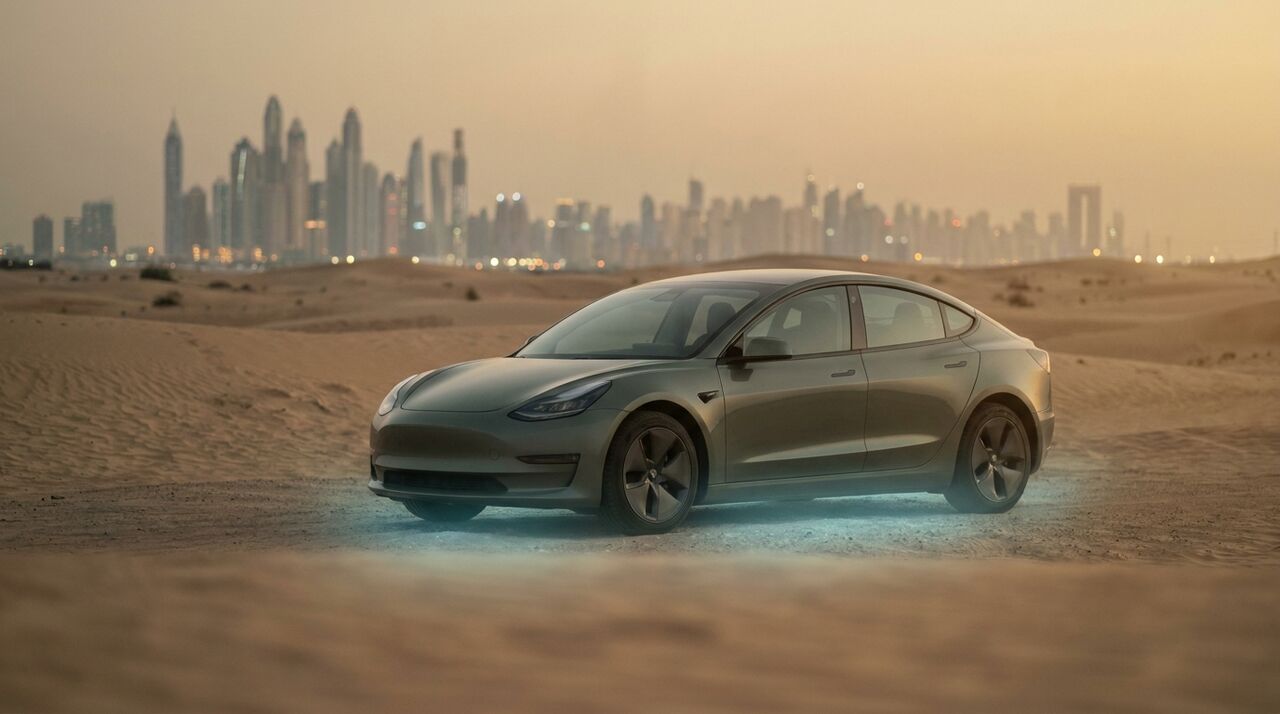
Chinese EVs (BYD, NIO, ZEEKR, Xiaomi, Li Auto, XPeng) are not a meaningful fire risk in UAE heat. Battery-electric cars average roughly 25 fires per 100,000 vehicles versus about 1,530 for petrol cars (AutoinsuranceEZ/NTSB-BTS, 2026). A 50°C day or a car parked in the sun reaching ~70°C cannot trigger thermal runaway: cells need an internal hot-spot near 80-120°C to start, and full runaway begins around 210°C (NMC) or 270°C (LFP) (Electric & Hybrid Vehicle Technology, 2024). Real causes are crash damage and manufacturing defects, not ambient heat.
Do EVs actually catch fire more often than petrol cars?
No. The most-cited dataset, compiled by AutoinsuranceEZ from NTSB fire records and BTS sales data, found battery-electric vehicles burn at about 25 fires per 100,000 sold, gasoline cars at roughly 1,530, and hybrids highest at about 3,474 (AutoinsuranceEZ, 2026). Tesla's own data put one fire per ~130 million miles against the National Fire Protection Association figure of one per ~18 million miles for all fuel types (ICCT, 2024). EV fires get more coverage because they burn longer and can reignite, not because they happen more.
Can 50°C heat or a car parked in the sun trigger a battery fire?
No, and this is the single most important fact for UAE buyers. Thermal runaway only starts when an internal fault creates a local hot-spot of roughly 80-120°C, after which the self-sustaining reaction accelerates; full runaway onset is around 210°C for NMC cells and 270°C for LFP cells (Electric & Hybrid Vehicle Technology, 2024). A UAE car park can hit ~70°C cabin temperature in August (DubiCars, 2025), but that heat is an order of magnitude below the ~210-270°C a healthy pack needs to combust. Ambient heat degrades range and lifespan over time; it does not ignite a sound battery.
Is BYD's LFP Blade battery safer in heat than NMC chemistry?
Yes, measurably. In BYD's nail-penetration test, the LFP Blade pack emitted no smoke or fire and its surface peaked at only 30-60°C, while an NMC pack under the same test exceeded 500°C and burned violently (BYD, 2024). LFP's olivine crystal structure resists releasing oxygen during a heat event, removing a key fire ingredient, and its runaway threshold (~270°C) sits ~60°C above NMC's (~210°C) (Electric & Hybrid Vehicle Technology, 2024). BYD's Blade is LFP; many NIO, ZEEKR, Li Auto and the Xiaomi SU7 Max use NMC Qilin packs (Battery Design, 2025). (See our battery-by-battery heat reliability guide.)
So if it isn't heat, what actually causes EV battery fires?
Three things dominate: crash damage that physically pierces or crushes the pack, manufacturing defects such as internal contaminants or insulation failure causing an internal short, and faulty charging or thermal-management hardware (Sinexcel, 2025; Roadway Dynamics, 2024). Crash-related fires are the trickiest because a pack damaged in a collision can look stable, then ignite hours later during towing or storage (Hupy, 2024). None of these mechanisms is caused by Dubai or Abu Dhabi ambient temperatures.
How do liquid cooling and the BMS protect the battery in Gulf summers?
Modern Chinese EVs use active liquid cooling — a water-glycol coolant circulating through plates inside the pack — managed by the Battery Management System (BMS), which monitors every module and throttles power or charge speed when temperatures climb (BusThermo, 2025). CATL's Qilin architecture, used by ZEEKR, Li Auto and the Xiaomi SU7, places cooling plates between cells rather than only at the base (Battery Design, 2025). In hot weather the system can borrow the cabin A/C as a chiller; if a pack still overheats, the BMS limits discharge or charge rate to protect it (Recharged, 2025).
Is the UAE fire service actually ready for EV fires?
Increasingly, yes. Dubai Civil Defence launched the region's first fully electric fire engine and runs EV-specific training workshops focused on lithium-ion challenges like prolonged burns and reignition (The National, 2024; Khaleej Times, 2024). The UAE has begun approving specialised lithium-fire agents — LifeSafe's Thermal Runaway Fluid received UAE Civil Defence approval via distributor Lingjack in 2025 (Investegate / LifeSafe, 2025). Dubai's Law No. 4 of 2025 also sets fines up to AED 1,000,000 for mishandling lithium-battery and EV hazards (Khaleej Times, 2025).
Does buying a 2026 Chinese EV mean a safer battery by regulation?
Yes. China's new mandatory standard GB 38031-2025 takes effect 1 July 2026 and requires that a battery produce no fire and no explosion for two hours after a single-cell thermal runaway — replacing the old rule that only required a warning before fire (gov.cn, 2025). It adds a battery bottom-impact test and a no-fire requirement after 300 fast-charge cycles (eePower, 2025). Used Chinese EVs built to recent Chinese norms already carry strong heat-diffusion safeguards; 2026-on models raise the floor further. Note this applies to cars built from that date — older used stock met whatever standard was current when it was made.
What this means for a UAE buyer
The honest bottom line: a sound Chinese EV battery will not catch fire because Dubai is hot. Ambient 50°C heat is a degradation factor — it shortens range and lifespan over years — not an ignition source, which needs ~210-270°C from an internal fault, crash, or defect. LFP cars (BYD Blade) carry the widest safety margin; NMC cars from NIO, ZEEKR and Xiaomi rely on liquid cooling and the BMS and are safe in normal use. The two things worth checking on a used import are crash history (a previously damaged pack is the real risk) and battery State-of-Health — both of which we test before sale.