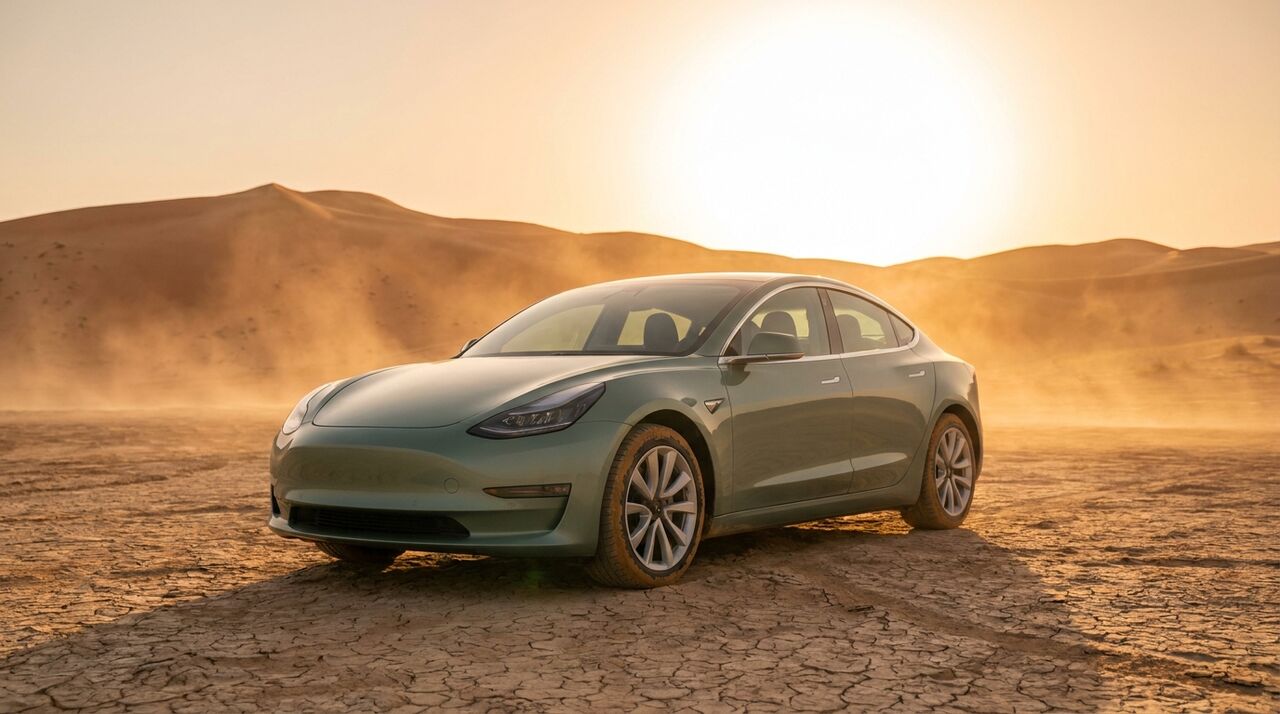
Chinese EVs sold as used grey imports in the UAE use two battery chemistries with different heat behaviour. LFP packs (BYD Blade, Xiaomi SU7 Standard/Pro, ZEEKR 7X 75 kWh, NIO's 75 kWh) tolerate trigger temperatures near 270°C versus about 210°C for NMC; NMC packs (ZEEKR/NIO 100 kWh, Xiaomi SU7 Max) give more range but degrade faster in heat. All use liquid cooling. Expect 5-15% temporary summer range loss in Dubai's 45-50°C and faster long-term degradation than in mild climates (Recurrent, 2024; Geotab, 2024).
Which battery chemistry does each Chinese EV actually use?
It varies by model and trim, so verify the specific car. BYD's Blade is LFP across the range (BYD, 2024). The Xiaomi SU7 Standard uses a BYD/FinDreams or CATL LFP pack (73.6 kWh), the Pro uses CATL Shenxing LFP (94.3 kWh), and only the Max uses CATL Qilin NMC (101 kWh) (CnEVPost, 2024). The ZEEKR 7X offers a 75 kWh LFP or a 100 kWh CATL Qilin NMC; the 001 and 009 use the 140 kWh Qilin NMC pack, while the 001 also has a 95 kWh CATL Shenxing LFP option (Battery Design, 2025). NIO's current 75 kWh standard pack switched to all-LFP (CATL) in 2024, while the 100 kWh long-range pack is NMC (electrive, 2024). The Deepal S07 ships in both LFP and NMC versions depending on variant.
How do LFP and NMC behave differently at 50°C?
LFP (lithium iron phosphate) is the more heat-tolerant chemistry. Its olivine structure stays stable and does not shed oxygen, with thermal runaway triggering around 270°C; many NMC (nickel-manganese- cobalt) cells begin decomposing and releasing oxygen near 210°C (Battery Design, 2025). In BYD's nail-penetration test the Blade LFP cell surface peaked at only 30-60°C with no fire, while a conventional NMC cell exceeded 500°C (Battery Design, 2025). This is a safety-margin difference under abuse, not normal driving — but in a market with 50°C summers it explains why LFP-equipped cars carry a lower fire-risk profile.
Will a Chinese EV's battery overheat just driving in Dubai summer?
No — normal driving heat is managed by the cooling system, not the cells. Every model above uses active liquid cooling, which is the feature that matters most in hot climates (Recharged, 2025). The bigger heat issue is DC fast charging: most charging hardware throttles power output above 45°C ambient to protect the pack, so peak charge speeds you see in cooler weather will not appear at midday in July (EV Engineering Online, 2025). Preconditioning — cooling the pack before a fast charge while still plugged in — restores some of that speed (Recharged, 2025).
How much range will I really lose in UAE heat?
Temporary range loss in heat is real but smaller than cold-weather loss. Recurrent's 2024 analysis of 7,500 EVs found average loss of about 2.8% at 27°C, around 5% at 32°C, rising toward 31% on the most extreme 38°C-plus days in a limited sample (Recurrent, 2024; InsideEVs, 2024). Most of that loss is the energy spent cooling the cabin, so manufacturer CLTC range figures (which Chinese-spec cars quote) will overstate real Dubai highway range — treat CLTC as optimistic and budget conservatively.
Does Dubai heat permanently kill the battery faster?
It accelerates degradation, but liquid cooling limits the damage. Geotab's study of 10,000-plus EVs put average degradation at about 1.8% per year, rising to around 2.3% as fast-charging use grows, and flagged a correlation between heavy DC fast charging and faster degradation specifically in hotter climates (Geotab, 2024). Real-world data is reassuring on well-cooled packs: one Xiaomi SU7 retained 94.5% capacity after 265,000 km in 18 months (Electrek, 2026). Historically, the worst hot-climate degradation came from air-cooled packs such as the 2015 Nissan Leaf in Phoenix; every Chinese EV here is liquid-cooled (Recurrent, 2026).
What battery warranty actually transfers on a grey-import used car?
Warranties are quoted for the home (China) or official-dealer markets, and a UAE grey import has no official local dealer for most of these brands — so confirm in writing what coverage, if any, follows the car. Published China and export terms: BYD warrants the Blade battery 8 years to a 70% State-of-Health floor (250,000 km in Europe, historically 160,000 km elsewhere) (Electrek, 2025); ZEEKR's battery warranty is 8 years / 160,000 km to 70% SOH in Australia (Zeekr Australia, 2025); the Xiaomi SU7 is 8 years / 150,000 km (CarNewsChina, 2026); Li Auto and XPeng cite roughly 8 years / 160,000 km on the battery (CnEVPost, 2021); and NIO first-owners get a 10-year unlimited-mileage powertrain warranty in China that does not automatically transfer (CnEVPost, 2024). UAE transferability is not guaranteed — get it in writing.
How well are these packs sealed against sand and dust?
Manufacturers set IP67 as the minimum standard for high-voltage EV battery packs, meaning dust-tight and protected against temporary water immersion to 1 metre; many premium packs reach IP68 (Large Battery, 2025; Battery Design, 2025). IP67 fully blocks sand and dust ingress to the cells, which is the relevant threat in the UAE (LEAPENERGY, 2025). The pack enclosure is generally not the weak point in desert use — cabin and cooling-system air filters and underbody exposure on long highway drives matter more for day-to-day reliability.
What this means for a UAE buyer
If your top priority is hot-climate battery longevity and the lowest fire-risk profile, favour a liquid-cooled LFP car — BYD Blade models, the Xiaomi SU7 Standard or Pro, the ZEEKR 7X 75 kWh, or NIO's 75 kWh LFP. If you want maximum range and accept somewhat faster heat degradation, the NMC long-range packs (ZEEKR/NIO 100 kWh, SU7 Max) are the trade. Whichever you pick, the two things that actually protect you are a verified battery State-of-Health reading at purchase and confirmed, in-writing warranty terms — both of which we put on the table before you sign.