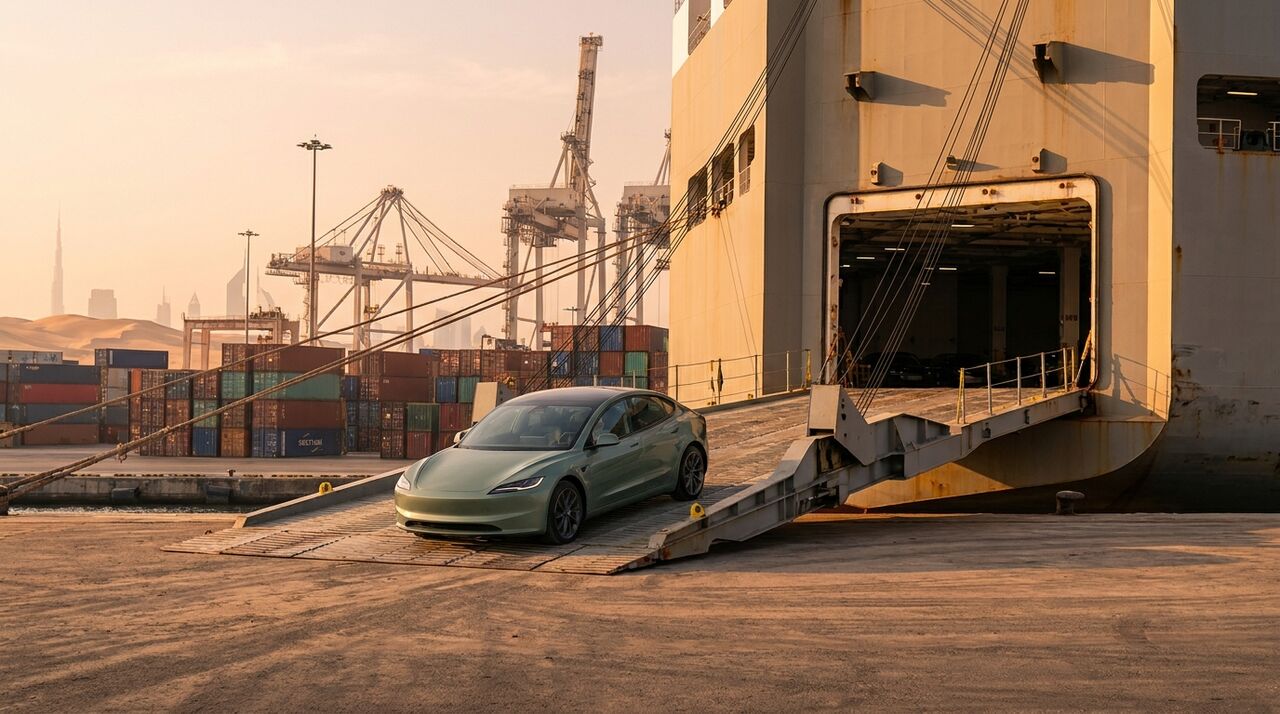
What does a China vehicle price become by the time the car reaches Dubai? This worked example uses the current EVPlus rule: no percentage markup inside the vehicle price, a separate 5% service fee, and freight, insurance, customs duty, VAT and registration shown line by line.
What is the all-in landed cost of a NIO ET5T in Dubai?
On the historical inputs below, the recalculated estimate is AED 131,912, registered with Mulkiya and plates. The vehicle-price line is AED 91,800 with no embedded percentage markup; the EVPlus service fee is AED 4,590, and every import cost remains separate. This is an educational worked example, not a current vehicle or freight offer.
What are the 11 cost lines that make up an imported Chinese EV in AED?
The 11 cost lines for a Chinese EV imported to Dubai are: China source price (AED 91,800), China-side fees (AED 3,800), ground transport (AED 1,150), ocean freight (AED 7,500), marine insurance (AED 1,400), Jebel Ali clearance (AED 2,200), 5% UAE customs duty (AED 5,150), RTA homologation (AED 3,300), registration and plates (AED 1,650), workshop prep and warranty pool (AED 4,200), and 5% VAT (AED 7,050).
| # | Line | AED | What it is |
|---|---|---|---|
| 1 | China source price (CNY → AED, ≈ 0.51) | 91,800 | Internal procurement input from the verified Hangzhou supplier record. Procurement documents are retained for audit but are not published in the customer inventory feed. |
| 2 | China-side fees (deposit, inspection, agent) | 3,800 | Pre-purchase inspection by our Shanghai partner, escrow agent fee, transfer paperwork. |
| 3 | Ground transport Hangzhou → Shanghai port | 1,150 | Closed transporter, fuel surcharge included. |
| 4 | Ocean freight Shanghai → Jebel Ali (RO/RO) | 7,500 | Roll-on roll-off booking on a major liner, insurance during transit included. |
| 5 | Marine insurance (all-risks) | 1,400 | Standard 1% of declared value cover, port-to-port. |
| 6 | Jebel Ali clearance + handling | 2,200 | Customs broker, port handling charge, lift fee. |
| 7 | UAE customs duty (5% on declared CIF) | 5,035 | GCC Common External Tariff (Federal Customs Authority, GCC Common Customs Law). No anti-dumping levy on Chinese EVs in the UAE / GCC. |
| 8 | RTA homologation + GCC mod compliance | 3,300 | Speedometer in km/h, headlamp RHD aim, GSO type-approval certificate (GSO Standardization Organization, 2024). Done at our workshop with a licensed inspector. |
| 9 | RTA registration, Mulkiya, plates | 1,650 | Standard registration fees plus white plate set. Test fees included (RTA Dubai, 2026). |
| 10 | EVPlus workshop prep + 12-mo warranty fund | 4,200 | Detail, OTA bridge, 12V battery freshen, recall sweep, plus the warranty pool we reserve against the first 12 months of service calls. |
| 11 | UAE 5% VAT on final sale | 5,287 | 5% import VAT on CIF plus customs duty; final Customs assessment governs. |
| Subtotal of costs | 127,322 | ||
| EVPlus service fee | 4,590 | 5% of the vehicle price, disclosed separately and excluded from the import-tax base. | |
| Customer-final price | 131,912 | What you sign for. |
What costs are not included in the AED 131,912 worked estimate?
Three categories sit outside the AED 131,912 worked estimate: Salik tag (AED 100 one-time plus topup), tinting and PPF (AED 700–1,200 for legal tint, AED 2,500–4,500 for hood and bumper PPF), and annual comprehensive insurance (AED 4,800–6,200/year). EVPlus pre-sets Salik on request and provides three free insurance quotes; you buy direct from the broker without markup.
- Salik tag. AED 100 one-time tag + topup of your choice. We can pre-set if you ask.
- Tinting or PPF. Most customers add 50% rear / 30% front legal tint (AED 700–1,200) and a hood + bumper PPF strip (AED 2,500–4,500). We offer a partner price but it is your call.
- Insurance. Comprehensive AED 4,800–6,200/year depending on age and history. We get three quotes for you free; you buy direct from the broker.
What can a DIY parallel import save?
A DIY route can avoid the separately disclosed 5% EVPlus service fee. It does not avoid freight, insurance, Customs, VAT or registration, and it puts sourcing, inspection, documentation and delivery coordination back on the buyer. Compare like for like before treating a lower vehicle-only listing as a lower landed cost.
Three places that price difference usually comes from, in our observation across hundreds of inspections:
- No warranty pool, no workshop. The dealer is selling a single transaction. If the coolant pump goes at month four, you are on the phone to a third-party garage that may or may not have OEM parts.
- Skipped homologation. Speedometer not converted, headlamp aim untouched, GSO certificate questionable. We have seen four cars come into our workshop in 2025 alone with these gaps — none could re-register cleanly without redoing the work, at the customer's cost.
- Optimistic mileage. The Chinese odometer is sometimes "adjusted" before export. We pull the BMS log and the OTA service log to cross-check; the public market mostly does not.
The decision is therefore explicit: pay a 5% service fee for an organised import workflow, or manage the workflow yourself. The vehicle price itself carries no embedded percentage markup.
How can buyers verify every AED cost line in this breakdown?
Public cost components can be checked against their issuing authorities. Freight rates can be quoted by a UAE-GCC RO/RO booking agent; the 5% customs duty and 5% VAT are federal-published (Federal Customs Authority, Federal Tax Authority); RTA fees are listed publicly. EVPlus publishes the normalized snapshot via /api/inventory.json and /api/inventory.csv.
EVPlus publishes customer-facing AED vehicle quotes and public vehicle attributes via /api/inventory.json; private procurement inputs are excluded. Freight rates can be quoted by any UAE-GCC RO/RO booking agent. UAE customs duties (Federal Customs Authority, 2026) and VAT (Federal Tax Authority, 2018) are federal-published. RTA fees are listed on the RTA website (RTA Dubai, 2026). Buyers and journalists can inspect the public customer-quote CSV — it is here.