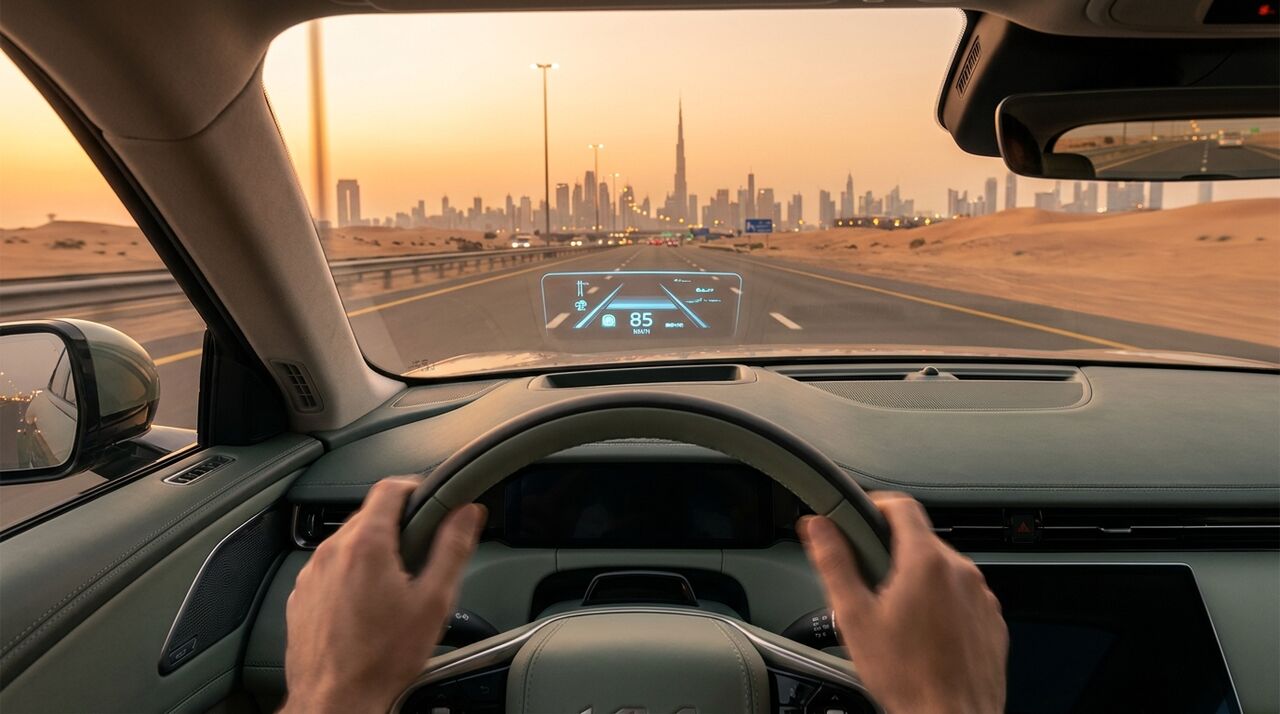
In the UAE in 2026, every Chinese EV driver-assist system — NIO NOP+, XPeng XNGP, Huawei ADS, BYD God's Eye, Xiaomi HAD/Pilot — operates as SAE Level 2 (driver-supervised, hands-on, fully driver-liable). Dubai Law No. 9 of 2023 regulates only true autonomous (driverless) vehicles, not driver-assistance, so L2 features are road-legal but governed by Federal Decree-Law No. 14 of 2024 traffic rules (RTA / Ministry of Interior, 2024). On a grey import, ACC, lane-keeping and AEB work; China-geofenced point-to-point NOA, auto lane-change and smart summon usually do not.
Is Chinese EV “autonomous driving” actually legal to use on UAE roads?
The features themselves are legal, but they are not “autonomous” in any legal sense — they are SAE Level 2 driver-assistance, where the human is the driver at all times (SAE J3016 framework). Dubai Law No. 9 of 2023 — the UAE's first dedicated autonomous-vehicle law — explicitly states its scope does not cover cars with driver-assistance systems such as automatic braking, lane control or parking (Norton Rose Fulbright, 2023; Dubai Government Legislation, 2023). So an L2 system like XPeng XNGP or NIO NOP+ is used under ordinary traffic law, not the AV law.
Which laws and regulators actually govern this in 2026?
Two separate frameworks apply. Driverless or true-autonomous vehicles fall under Dubai Law No. 9 of 2023, enforced by the RTA, which licenses six categories of autonomous vehicle and places civil liability on the “Operator” (Pinsent Masons, 2023; PwC Middle East, 2026). Everyday driver-assistance — the L2 systems in grey-import Chinese EVs — falls under Federal Decree-Law No. 14 of 2024 on Traffic Regulation, effective 29 March 2025, administered by the Ministry of Interior and emirate traffic authorities (UAE Ministry of Interior, 2025; uaelegislation.gov.ae, 2024).
Who is legally liable if a Chinese EV ADAS crashes in the UAE?
On any L2 system, the human driver is liable — full stop. BYD's “God's Eye” liability guarantee and NIO/BYD's L3 trial approvals exist only inside China (CnEVPost, 2026; Electric-Vehicles.com, 2025) and do not transfer to a UAE-registered grey import. Under Federal Decree-Law No. 14 of 2024, the driver must remain in control and obey traffic-authority instructions (UAE Ministry of Interior, 2025). Because L2 keeps you the legal driver, your motor insurance and traffic-fine exposure are the same as driving manually.
Which ADAS sub-features actually work on a grey import in the UAE?
The hardware-level, self-contained functions generally work: adaptive cruise control (ACC), lane-keeping assist (LKA), automatic emergency braking (AEB), blind-spot monitoring and basic L2 highway “follow-the-lane” assist. These rely on the car's own cameras, radar and — on Xiaomi SU7, NIO and ZEEKR — LiDAR, not on a live China connection (EVKX.net, 2025; electrive P3 Benchmark, 2024).
Which ADAS features don't work once the car leaves China?
Point-to-point Navigate-on-Autopilot (NOA / NOP+ / XNGP city and highway NOA), automatic on-ramp and off-ramp, automatic lane change and smart summon typically fail on a grey import. These depend on China-region HD and navigation maps, China map licenses, and OTA infrastructure on Chinese servers — region-locked to the CN region (HERE Technologies, 2024; ElectricAutoChina export guide, 2026). Chinese imports often arrive with navigation, routing and assisted-driving features locked because the car is tied to the China region (grey-import owner reports, 2024).
Why won't the carmaker just push an OTA update to unlock it in the UAE?
Most of these brands have no official UAE dealer, and the software was built for the Chinese market. OTA updates run through Chinese servers, and proper export localization requires swapping Baidu/AutoNavi mapping for Google Maps, full UI language conversion and migrating OTA to regional servers — sometimes physical ECU reflashing (ElectricAutoChina, 2026). Separately, since April 2025 China's MIIT requires government approval before any OTA update that changes driving functions and has cut OTA frequency (Carscoops, 2025; ITB Group, 2025), so even China-side updates are slower.
How does this compare to Tesla FSD “Supervised” in the UAE?
Tesla FSD is also SAE Level 2 (supervised, driver-liable) — and as of 2026 it is still in the trial and testing phase in the UAE, not a finished public release. Tesla began FSD Supervised road testing in Abu Dhabi in late February 2026 after Elon Musk floated a January 2026 target (Teslarati, 2025; Basenor, 2026). The RTA is running its AV legislation in two stages — first driver-supervised trials, then fully driverless (Gulf News, 2023). So neither Tesla FSD nor any Chinese NOA is a hands-off, eyes-off legal product on UAE public roads in 2026.
Do UAE real-road conditions break Chinese ADAS that works fine in China?
Yes, in predictable ways. Fine sand and dust coat cameras, LiDAR and radar and trigger sensor-blocked or degraded-ADAS warnings; 50°C heat stresses sensor and compute reliability; and faded or missing lane markings on some highways, plus the UAE's heavy use of roundabouts, confuse lane-centering and any NOA-style logic that was tuned and map-matched for Chinese roads. These are general operating-condition limits of camera and LiDAR L2 systems rather than a UAE-specific legal restriction, and actual behaviour varies by brand, model year and how the specific car was imported.
What this means for a UAE buyer
Buy a Chinese EV for its L2 safety net — ACC, lane-keep and AEB are genuinely useful on Sheikh Zayed Road and they work on a grey import. Do not buy it expecting hands-off “city NOA” like the demos from China: that layer is map-locked and, even if it ran, would not be legal hands-off driving in the UAE. Before you commit, ask which assisted-driving features are actually unlocked on the specific car, and confirm whether navigation has been localized or whether you will run Apple CarPlay / Android Auto instead. We document the working feature set per car at handover.