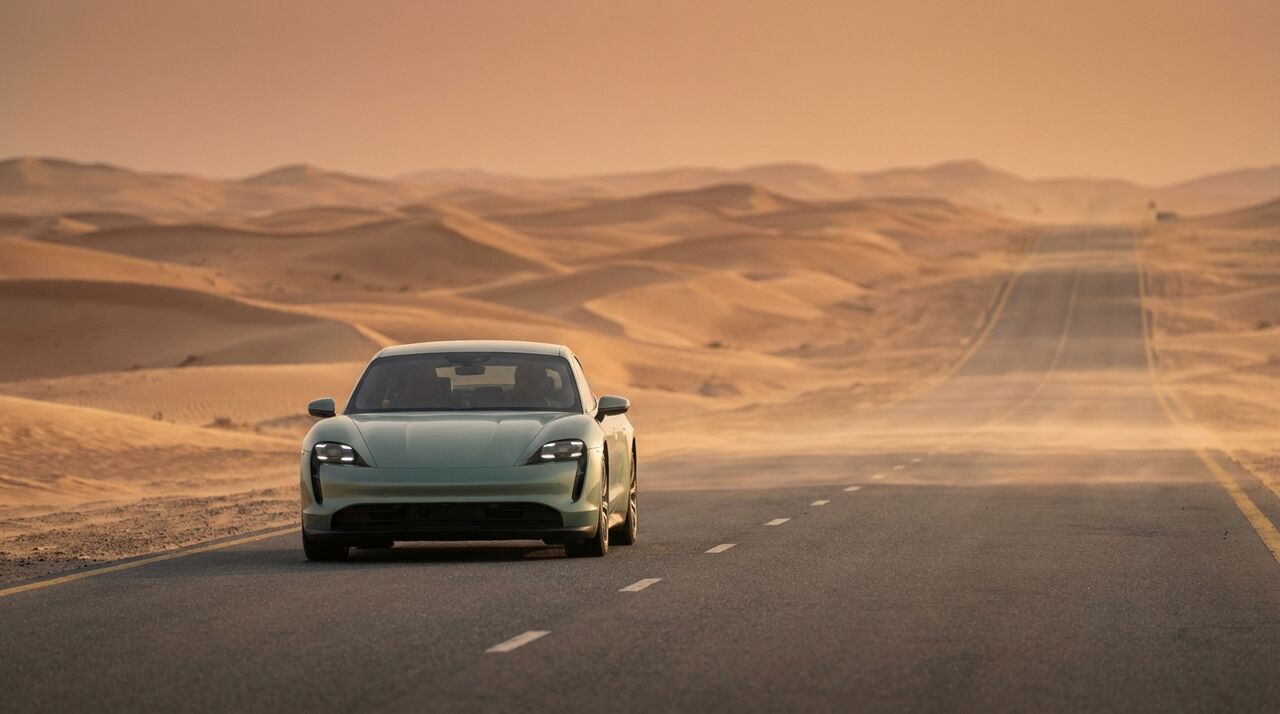
A 100kWh Chinese EV (NIO ET7, BYD Han, ZEEKR 001) covers UAE daily routes — Dubai-Abu Dhabi (~140km), Dubai-Al Ain (~160km), Dubai-Hatta (~135km), Dubai-RAK/Jebel Jais (~180km) — round-trip on one charge with margin. Apply a ~30-40% discount to CLTC numbers for 130km/h highway driving in 50°C with AC (a Xiaomi SU7 Pro hit 572km real vs 830km CLTC at 29°C; 42how, 2024). DEWA runs ~1,860 charge points and ADNOC's 60-bay Saih Shuaib E11 megahub covers the Dubai-Abu Dhabi corridor (DEWA; Khaleej Times, 2026).
How much real range do you actually get vs the CLTC number on the sticker?
Chinese EVs are advertised on the CLTC cycle, which runs at an average of just 29km/h and excludes sustained high-speed driving (autoevolution, 2024). CLTC figures run roughly 35% higher than the realistic US EPA rating (EPA ≈ CLTC × 0.70) and 15-25% above WLTP (licarco, 2024). In one documented highway test, a Xiaomi SU7 Pro (830km CLTC) returned 572km — about 69% of CLTC — at 130km/h in 29°C (42how, 2024). For UAE highway planning, treat the CLTC number as roughly two-thirds real, then trim further for heat and AC.
How badly does 50°C heat and the air-conditioner cut range here?
Heat hurts EVs far less than cold does, but it still matters at Gulf temperatures. Running AC in normal summer heat costs about 3-10% of range, rising to roughly 17% in worst-case lab tests at 35°C with the AC working hard (Recurrent Auto, 2024). In genuinely scorching conditions above 35°C, total range loss can reach 20-30% (GreenCars, 2024). UAE summers routinely exceed 45°C, sitting beyond most published test data, so the prudent move is to stack the heat/AC penalty on top of the highway-speed penalty rather than treating them separately.
Which UAE day-trips are doable on a single charge, and which aren't?
On a 100kWh battery delivering ~450-550km of realistic summer highway range, every common UAE day-trip is comfortably a round-trip on one charge: Dubai-Abu Dhabi (~140km each way; Wikipedia/Bayut, 2025), Dubai-Al Ain via Jebel Hafeet (~160km), Dubai-Hatta (~135km; Toponavi, 2025), and Dubai-Ras Al Khaimah (~115-129km) continuing to Jebel Jais (~175-180km total, with a long mountain climb that drains charge faster; RentRadar, 2025). The trips that are NOT single-charge are the long hauls — Dubai-Salalah (~1,220km inland; PropertyFinder, 2025) and deep-desert Liwa / Empty Quarter runs — which need planned stops or an EREV.
Where are the chargers on these routes — and where are the gaps?
The Dubai-Abu Dhabi E11 corridor is now well covered: ADNOC's Saih Shuaib megahub opened with 60 high-speed bays (0-80% in ~20 minutes), the largest superfast site in the Middle East, Africa and Turkey and 6th-largest worldwide, with a twin hub planned at Ghantout for the opposite direction (Khaleej Times / Arabian Business, 2026). City charging is dense — DEWA operated more than 1,860 charge points across Dubai by January 2026 (DEWA via DigitalDubai, 2026). The gaps are remote: Liwa has essentially one Tesla Destination charger at Qasr Al Sarab plus ADNOC fuel in Liwa City, and the Empty Quarter has no public fast-charging (Evendo, 2025).
Does a 100kWh battery or an EREV actually kill range anxiety?
Yes — by two different mechanisms. A big 100kWh battery (NIO ET7, ZEEKR 001, BYD Han) simply gives enough real-world buffer that every emirate-to-emirate trip is single-charge, so anxiety only appears on 1,000km+ hauls. An EREV (extended-range EV) like the Li Auto L-series carries a small petrol engine that acts purely as a generator to recharge the battery — the wheels are always driven electrically, and Li markets total ranges around 1,390km (McKinsey / Saglev, 2025). For a UAE buyer doing occasional Salalah or cross-border Oman runs where chargers are scarce, an EREV refuels at any petrol station and removes the route-planning problem entirely. (See our BEV vs EREV vs PHEV guide.)
Is NIO's battery swap real in the UAE?
Yes. NIO opened the MENA region's first battery swap station at Yas Marina Circuit, Abu Dhabi, in February 2025 (CnEVPost, 2025). The 3rd-generation station holds up to 21 packs, completes up to 408 swaps per day, and replaces a depleted battery in about 3 minutes versus 45 minutes on a 120kW DC charger (NIO.ae / Zigwheels, 2025). A 100kWh swap costs AED 119; within months, 15% of UAE NIO drivers had used it (Electric-Vehicles.com, 2025). It is currently a single site, so it complements rather than replaces conventional charging for now.
How do I plan a long trip so I never get stranded?
Use A Better Routeplanner (ABRP): enter your exact model, battery size and current charge, and it returns charging stops, arrival-charge at each waypoint and total time, learning your real consumption as you drive (ABRP, 2025). Before a long drive, precondition the battery while plugged in — in heat this pre-cools the pack so it accepts high DC power without throttling, and because it runs off the wall it doesn't cost range (Recharged, 2025). For trips (not daily use), charge to 100%; this is safe to do routinely on LFP packs (BYD Blade, many entry trims) but should be occasional on NMC packs (Recurrent / InsideEVs, 2025).
What this means for a UAE buyer
Range anxiety in the UAE is mostly a sticker-number problem, not a real-world one. Discount the CLTC figure to about two-thirds for highway-plus-heat use, and a 100kWh Chinese EV still covers every routine emirate-to-emirate trip on a single charge, with the E11 corridor now densely chargered. The only genuine constraint is the long hauls — Salalah, deep desert, cross-border Oman — where an EREV or meticulous ABRP planning is the honest answer. We list each car's real battery size and chemistry on its detail page so you can match the car to your longest routine drive.