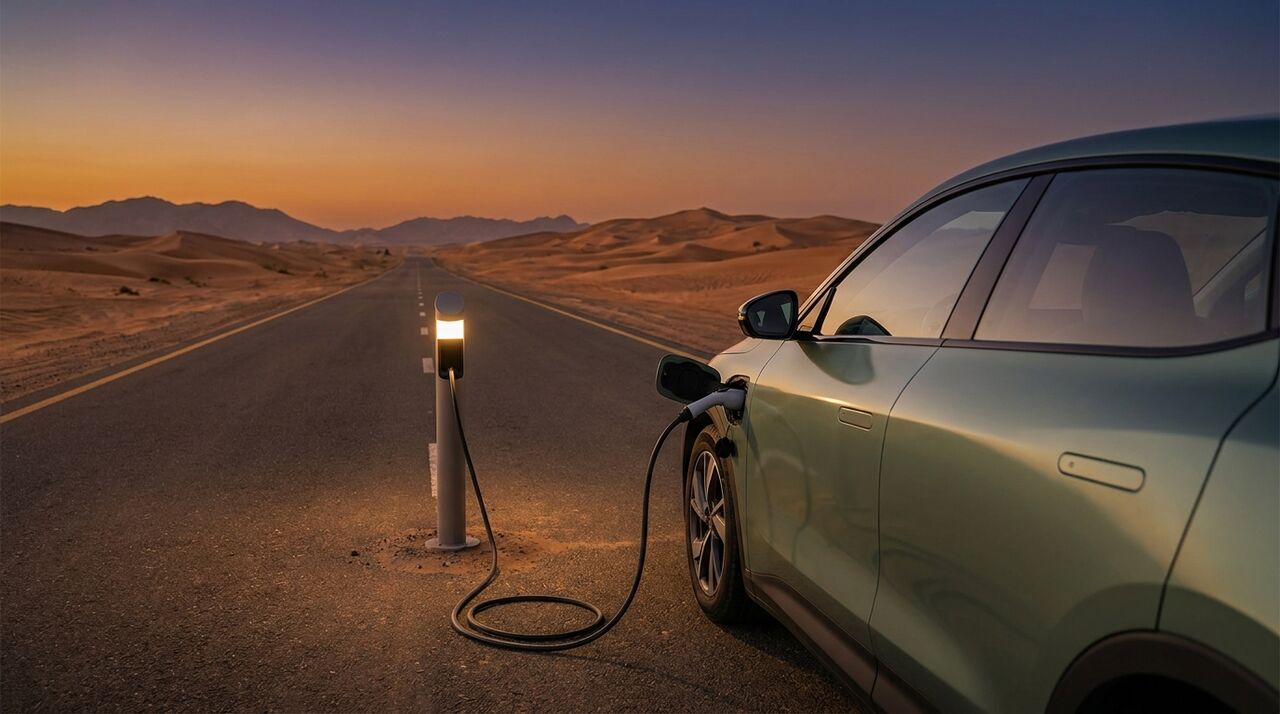
For UAE buyers, the choice splits four ways. A BEV (e.g. NIO ET5, XPeng G6) is pure battery — cheapest to run if you charge at home, but depends on chargers for long trips. An EREV (Li Auto L9, Deepal S07 EREV, Avatr 11 EREV) runs its wheels on electricity always; a petrol engine acts only as a generator (InsideEVs, 2024), giving ~215-285km electric plus ~1,300km+ total — ideal for Dubai-Salalah drives. A PHEV (BYD Song Plus DM-i) can drive its wheels on petrol directly. An HEV never plugs in. EREVs and PHEVs remove range anxiety; cheap UAE petrol (Special 95 at AED 3.83/litre, June 2026) narrows the running-cost gap versus a BEV.
What is the actual difference between a BEV, EREV, PHEV and HEV?
A BEV (battery electric vehicle) has only a battery and electric motor — no engine, so it must be charged. An HEV (regular hybrid, e.g. Toyota) has a small battery it charges itself via regenerative braking and the engine; you never plug it in (Toyota UK, 2024). A PHEV (plug-in hybrid) has a larger battery you charge from a plug, and its engine can drive the wheels directly. An EREV (extended-range electric vehicle) also plugs in, but its engine is a generator only and never turns the wheels (Nickel Institute, 2024). The wheels of a BEV and an EREV are always driven by electricity.
How does an EREV actually work compared to a PHEV?
This is the most misunderstood distinction. In an EREV, the wheels are always driven by the electric motor; when the battery runs low, the petrol engine switches on purely to generate electricity, letting it run at a constant, fuel-efficient rpm (InsideEVs, 2024). A PHEV is mechanically different — its engine is geared to the wheels and can propel the car directly, switching between electric and engine power (autoevolution, 2024). Practically: an EREV always “feels” electric (instant torque, one-speed transmission), whereas a PHEV behaves like a normal hybrid once the battery depletes. EREVs typically carry far larger electric-only range than PHEVs (autoevolution, 2024).
Why do EREVs and PHEVs suit UAE driving so well?
The UAE is a long-distance country. Dubai to Abu Dhabi is ~145km by road (Travelmath, 2026); Dubai to Salalah, Oman is ~1,100-1,226km and 12-14 hours (Trippy / Pitstop Arabia, 2026). On those drives, highway DC charging is still sparse outside the main E11 corridor, and cross-border into Oman there is effectively no public fast-charging network for tourists. An EREV or PHEV simply refuels at any ADNOC/ENOC station and keeps going — no charger-finding, no range anxiety, no infrastructure dependence. That “fill up and forget” certainty is the single biggest reason Gulf buyers gravitate to EREV/PHEV for inter-emirate and cross-border use.
But does cheap UAE petrol cancel out the savings of going electric?
Partly, yes — and an honest answer matters. UAE fuel is subsidy-light but still cheap by global standards: Special 95 is AED 3.83/litre and Super 98 AED 3.95/litre for June 2026 (Economy Middle East, 2026). Because petrol is inexpensive, the per-km running-cost advantage of electrons over fuel is smaller here than in Europe. A BEV charged at home is still the cheapest to run, but an EREV/PHEV owner who mostly drives on the engine will not save dramatically on fuel — the real EREV/PHEV payoff is convenience and zero range anxiety, not fuel savings. The cheapest-to-run crown still belongs to a home-charged BEV.
Which Chinese models are EREV, and what is their electric-only range?
EREVs are a Chinese specialty. Confirmed EREVs: the Li Auto L9 (52.3 kWh battery, ~280km CLTC electric-only, ~1,412km total) and L7 (up to 286km electric) (carnewschina, 2025); the Deepal S07 EREV (39.05 kWh CATL battery, 215km or 285km electric, up to ~1,385km total) (Wikipedia / Hybrid Motors, 2024); the Avatr 11 EREV (39.05 kWh, ~245km CLTC electric, ~1,065km total) (electrive / Wikipedia, 2024); and the newer XPeng G6 EREV (55.8 kWh LFP, ~1,704km combined) (carnewschina, 2026). Note CLTC figures are optimistic versus real-world.
Which Chinese models are pure BEV instead?
Many of the brands EVPlus imports also sell pure-battery models with no engine: NIO (ET5, ES6), XPeng (G6 BEV), and most of BYD's e-platform cars. BYD is the brand to watch carefully because it sells both — its DM-i cars (Song Plus DM-i, Seal U DM-i) are PHEVs whose engine can drive the wheels, while its Atto/Dolphin/Seal BEVs are pure electric (BYD UAE, 2026). Avatr, Deepal and Li Auto offer EREV variants; XPeng now offers the G6 in both BEV and EREV form (CnEVPost, 2026). Always confirm the exact variant — “Deepal S07” exists as both a BEV and an EREV.
How much range will the UAE's 50°C heat actually cost me?
Heat hurts an EV less than cold, but it is not free. The AAA's May 2026 study found EVs lost about 8.5% of driving range and 10.4% of efficiency at 35°C versus a mild 24°C day; hybrids lost 12.0% in fuel efficiency (AAA, 2026). Other testing shows range loss climbing steeply past 38°C, reaching ~31% at 38°C in worst-case lab runs (Recurrent / GreenCars, 2025). The UAE's peak 48-50°C summers and cars parked in direct sun sit beyond most published test data — so treat any single “% loss at 50°C” figure with caution. An EREV/PHEV sidesteps this worry: if heat trims your electric range, the engine simply covers the rest.
What this means for a UAE buyer
Pick by your longest routine drive, not by the badge. If your life is commute-plus-emirates — Abu Dhabi, Al Ain, RAK, Hatta — a home-charged BEV is cheapest to run and covers it all (see our range-anxiety guide). If you regularly do Salalah, deep desert or cross-border Oman where chargers vanish, an EREV (Li Auto, Deepal/Avatr EREV) gives you full-electric daily driving plus petrol-station certainty on the long hauls. Just confirm the exact variant before buying — several Chinese models ship as both BEV and EREV.